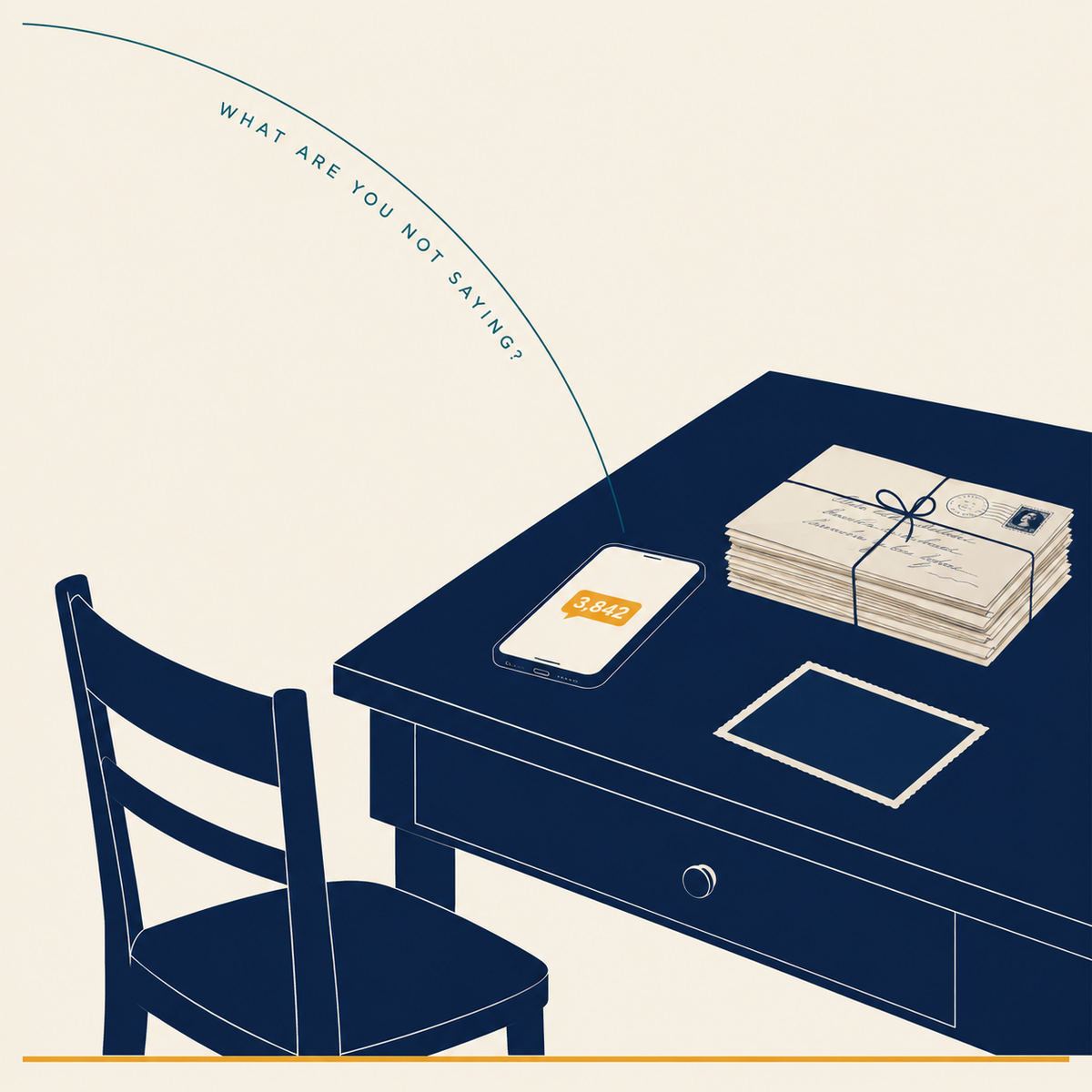
You will die with approximately 100,000 unread emails. Nobody has a plan for any of them.
By Lyndon Amoah | MNEME Studios
Somewhere, right now, there is a phone that belongs to someone who is no longer alive.
It has 4,200 photographs on it. Voice notes. A WhatsApp thread with a sibling that ends mid-sentence. A playlist titled something ordinary, like "morning" or "driving." Search histories. Location data. The last thing they Googled before they went to sleep.
Nobody knows the passcode.
Nobody thought to ask.
We have spent the last two decades building the most detailed, intimate, and comprehensive self-portrait in human history — and we have made almost no arrangements for what happens to it when we die.
The average person has dozens of online accounts. Emails stretching back fifteen years. Cloud storage full of photographs that have never been printed. Social media profiles holding a decade of thought, opinion, and feeling. Music libraries. Document archives. The private record of a life, distributed across thirty different servers in four different countries, governed by thirty different terms of service agreements that almost nobody has read.
When you die, almost none of it belongs to your family.
This is the part that surprises people.
Most digital content — movies, music, eBooks, is licensed, not owned. iTunes, Amazon, Google Play and other platforms typically grant you a non-transferable licence to use the content. When you die, that licence usually expires.
Your music library. Gone.
Your downloaded films. Gone.
The books you highlighted and annotated across twenty years of reading. Gone.
Yahoo maintains a "no right of survivorship" clause in its terms of service. LinkedIn will close an account on notification of death, but will not permit data access. Pinterest deactivates and leaves no mechanism for anyone to manage what remains. Snapchat will delete everything, on request, with a death certificate.
Google, to its credit, has built something called an Inactive Account Manager — a tool that allows you to decide in advance what happens to your data if you stop using it. It is opt-in. Hardly anyone has used it.
The Oxford Internet Institute has projected that by the end of this century, the number of deceased Facebook user accounts will reach nearly five billion.
Five billion lives. Suspended.
Most of us have never thought seriously about this. Not really. We know, vaguely, that death is a thing that happens. We do not think about the inbox.
But here is why it matters beyond the personal.
Archives have always been the institutions that decided what gets kept.
For most of recorded history, they collected paper, letters, diaries, ledgers, photographs, organisational records. The material that documented how communities lived, worked, mourned, organised, and resisted. The material that future generations would use to understand the present one.
The problem is that the present generation has stopped producing paper.
The oral history of a community leader today lives in their WhatsApp voice notes. The record of a community organisation's founding moment is in a group chat. The document of how a neighbourhood responded to a crisis is in a comment thread that will vanish the moment the platform decides to change its terms.
Archives trying to collect contemporary community history are not just dealing with a technical challenge. They are dealing with a structural one. The material exists. The access does not. And nobody - not the platforms, not the families, not the organisations - has made a plan.
I think about this a lot.
Not because it is abstract. Because the communities whose histories are most likely to be lost this way are the ones whose histories have always been most at risk. The communities that relied on oral tradition because the official record excluded them. The communities whose landing cards were destroyed. The communities whose stories were never considered archive-worthy by the people running the archive.
Those communities are now producing rich, detailed, contemporary records of their own lives, on their phones, in their group chats, across the platforms, and the infrastructure to preserve any of it barely exists.
The question of what happens to your data when you die is not just a question for estate lawyers and tech platforms.
It is a question for anyone who believes that memory matters. That the record of how people actually lived is worth protecting. That future generations deserve access to the present in the same way we have access to the past.
It is, in the end, an archival question.
And most of us are not treating it like one.
MNEME Studios helps cultural organisations think carefully about how emerging technology intersects with memory, access, and community. If that work feels relevant to yours, you can find us at mnemestudios.com