Crate Digging Is Archival Work
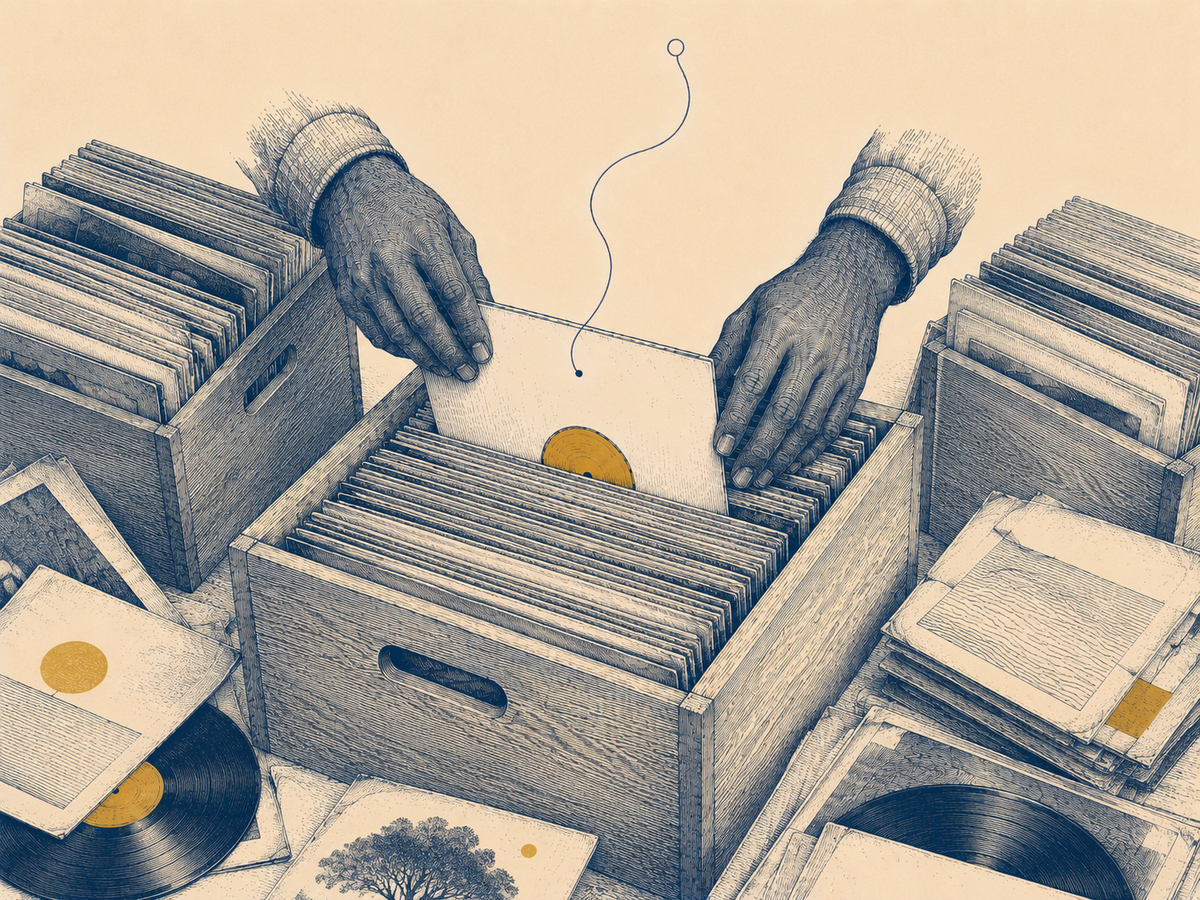
I was eleven or twelve when I found Donny Hathaway and Billy Paul in my parents' vinyl collection. I did not understand, at the time, that I had stumbled into one of the most powerful traditions in Black music. I just knew the voices were doing something to me. Hathaway, who died at thirty-three in 1979, had a slim catalogue and a sound that has only grown in stature in the decades since. Billy Paul, best known to most people for Me and Mrs Jones, was a Philadelphia International singer whose deeper work was being quietly reassessed by listeners discovering him on their parents' shelves, of which I was one.
I started looking for more. That was the beginning. From those two records I followed the threads outward, into the rest of Hathaway's small body of work, into Roberta Flack, into the wider Philadelphia International catalogue, into the soul and gospel and proto-disco that surrounded them. By the time I was older and travelling on my own, I was a crate digger. The word feels slightly performative typed out, but the practice is exactly what it sounds like: digging to the bottom of the record crate to find the lost, the obscure, the nearly forgotten. I had been doing it, in one form or another, for most of my life.
This essay is about what I think that practice actually is, and what it has to do with the work I now build my professional life around.
I first heard Gloria Ann Taylor in a random record store in Lisbon. The shop was small, the kind that holds maybe two hundred records and one person behind the counter who probably curated all of them. Love Is a Hurtin' Thing was playing. I Shazammed it from my phone, paid for whatever I had been pretending to look at, and walked back into the afternoon obsessed.
That song was recorded in 1973. It is seven and a half minutes long. A guitar burst opens it, distorted, almost wrong-sounding, and Taylor doesn't come in for nearly three and a half minutes. When she finally arrives, her voice is fully formed, fully strange, fully unlike anything in the soul of that era. It is proto-disco, years before disco existed as a category. It was pressed on a private label she ran with her husband. The master tapes are now lost — stored in her son's car in 1977 after she was evicted from her apartment, and the car was towed away. They have never been recovered.
About a year later, I was on Soulseek. For those who didn't move through the late 2000s and early 2010s in the way I did, Soulseek is a peer-to-peer network where people share music files directly. Some of it is licensed. Most of it is not. But for certain kinds of music — small-pressing soul singles, regional R&B, obscure Northern Soul records that never made it onto streaming services — Soulseek was, and to some extent still is, the only place this music actually lives. The official infrastructure does not hold it.
I was browsing someone's shared collection — blues and soul, mostly, with handwritten file names suggesting they'd been ripped from vinyl by the collector themselves. I came across Sugar Pie DeSanto.
She was four feet eleven inches tall. She did standing back flips on stage, in 1960, in a sequinned dress, opening for James Brown. Johnny Otis discovered her at a San Francisco talent show and signed her on the spot. Her father was a Filipino seaman from Manila. Her mother was a Black concert pianist from Philadelphia. She grew up in San Francisco poverty alongside a girl named Jamesetta Hawkins, who would later become Etta James. Sugar Pie got a $10,000 advance from Chess Records in the early 1960s, and they spent the next decade not paying her royalties, shelving most of her recordings, and keeping her writing songs in the back for other artists — Minnie Riperton, Fontella Bass, The Dells — apparently to ensure she would not outshine their other female blues singer, Koko Taylor. She was inducted into the Blues Hall of Fame in 2024, fifty-nine years after she signed with Chess. She died in December of that same year, aged eighty-nine.
I sat with that file collection for a long time. The energy on those recordings. The voice. The discipline of the dancer underneath the singer. The fact that she had been doing this for seventy years and most people I knew, including people who loved soul music, had never heard of her.
Neither of them reached me through a museum, an archive, a cultural institution, or a curated public programme. They reached me through the same channel that delivered Donny Hathaway to me when I was eleven, through the same kind of work I have been doing in record shops and shared folders and Discogs sellers and YouTube rabbit holes for most of my adult life. The recovery apparatus, as I have come to think of it, is a real thing. It operates parallel to the official infrastructure of cultural memory, and for certain kinds of artists it is the only thing that operates at all.
I want to be careful with the framing here, because the word parallel understates it. For a significant body of music, the recovery apparatus is the archive. There is no other.
When the master tapes are lost, when the original label folded forty years ago, when the rights have passed through five corporate acquisitions to companies that have no idea what they own, when the records were pressed in runs of two thousand and most of them have been broken or thrown out — what keeps the music alive is the network of people who care enough to maintain it and share it. The collector who spent thirty years assembling a Sugar Pie DeSanto archive on a hard drive is doing the work of an archivist. The acts of appraisal, organisation, preservation, metadata, and access that define archival practice are present in their work. The fact that institutions have not always recognised this work as archival is part of the argument, not a defeat of it.
I am not saying that all peer-to-peer file sharing is archival work. I am saying that for material the official market has abandoned, the people maintaining and sharing it are often the only reason it still exists. Some of this work is legally grey. Some of it would, in a different rights environment, be straightforward licensing. The grey area is not a function of the collectors having done something wrong. It is a function of the official market having walked away from the material, leaving its survival to whoever cared enough to do the work.
These people care with a particular intensity. The Sugar Pie collection I found on Soulseek had been compiled by someone who had clearly spent years tracking down B-sides, alternate takes, radio appearances. The Gloria Ann Taylor record playing in Lisbon was probably stocked by someone who had heard Love Is a Hurtin' Thing once and decided their shop had to carry it. The reissue labels — Luv N' Haight, Numero Group, Light in the Attic, Athens of the North, and dozens of smaller operations — are run by people whose business model barely works, sustained by love more than by economics. The Northern Soul collectors trading 7-inch pressings of Deep Inside of You for three thousand pounds are, in their own way, conservators. The Filipino-American magazine that profiled Sugar Pie in 2024 was doing biographical recovery that scholars should have done forty years earlier.
This is what the apparatus is. It is people, working with love and patience, often at financial cost to themselves, maintaining the existence of music that the official cultural memory sector has not protected. I have been one of these people, in my small way, since I was a child going through my parents' CDs.
The apparatus works. The reissues exist. The Bandcamp pages exist. Love Is a Hurtin' Thing did finally get a proper CD release in 2015, more than forty years after it was recorded. Sugar Pie DeSanto did finally get the Blues Hall of Fame induction in 2024. Wikipedia articles, written by people who cared enough, exist.
But the apparatus depends on chance. It depends on someone being in the shop. It depends on someone making the file available. It depends on a collector deciding to spend three thousand pounds on a 7-inch pressing. It depends on a reissue label founder being independently wealthy enough to take a risk on a record nobody else thinks will sell. Most artists at this level of obscurity do not get recovered. Most never get the Bandcamp page, the Wikipedia entry, the late-life Hall of Fame induction. They stay in the boxes of dead collectors. Their masters stay in the towed cars. Their records get melted down because nobody knew what they were.
This is the gap I think about all the time. Not the celebrated end of the cultural memory question — the high-profile reclamations, the prestigious reassessments. The other end. The artists too small to be reclaimed at scale, but too important to be allowed to disappear. The shop in Lisbon, multiplied. The Soulseek browse, made systematic. The patient, slightly obsessive work of looking again at material the official market has decided does not matter.
The cultural memory sector — museums, archives, heritage trusts, genre-specific institutions — does important work. The recovery apparatus would not exist without the institutional foundation underneath it. Wikipedia articles are written by people who can access archival materials that institutions preserved. The two systems are not enemies. They are co-dependent.
But the institutional sector has not, in any honest accounting, been the channel through which this music reaches the people who go on to care about it. The channel has been the apparatus, and the institutional sector has, in too many cases, treated this apparatus as adjacent rather than central to its work. The collector is doing archival work the official sector does not always recognise as archival. The reissue labels are doing curation that institutions should be sponsoring. The record shop in Lisbon is doing public programming that museums dream of doing.
This is what I think MNEME exists to address.
I do not run a record label. I do not have a reissue catalogue. I am not in the business of replicating what the recovery apparatus already does well. What I think the work is, instead, is to give institutions the tools to meet the listener at the moment of curiosity. To build the next step that follows the Lisbon shop or the Soulseek browse or the kid going through their parents' CDs — the step where the curious listener can ask an archive a question about Sugar Pie DeSanto and get a sourced, honest, useful answer. To structure the institutional material in a way that makes it answerable to the question the recovery apparatus has surfaced. To take what the museum has preserved and the collector has rediscovered and the listener has just heard, and join them up.
The tools to do this exist. They are imperfect. They have to be deployed with care, designed by people who take cultural specificity seriously, and built around the premise that the listener does not arrive in the language of the archive — they arrive in the language of curiosity. Sugar Pie DeSanto. Gloria Ann Taylor. That song that was playing in the shop. The institution's job, with the right tools, is to be ready when that question comes.
Gloria Ann Taylor is, as far as anyone reports, still alive. She lives in Toledo and sings in a church choir. Sugar Pie DeSanto died seventeen months ago. Both of them deserved, while they were alive, to know that the cultural memory of the music they made had been built before they died, by institutions taking that work seriously, in partnership with the people who have been doing it alongside them, with tools that make the music findable to the listener who has just been in a record shop in Lisbon and does not yet know what they have just heard.
That is the work. That is what MNEME is for.
This piece is part of an ongoing series on AI, memory, and cultural heritage. The recordings of both artists referenced here are available through Bandcamp, the Blues Foundation, and a handful of small reissue labels doing the patient work this essay is about.