Trust Cannot Be Automated
Lately, whenever I see AI mentioned online, the reaction is immediate.
Distrust. Fatigue. Irritation.
Someone posts a photograph and the comments fill with accusations of fakery. An illustration appears and people recoil before they even know how it was made. A company announces a new AI feature and the response is less excitement than exhaustion. Beneath all of this sits a growing sense that the internet itself is becoming synthetic.
I understand the reaction.
People are not responding to AI in isolation. They are responding to years of digital erosion. Algorithmic feeds that flatten attention into engagement metrics. Spam dressed as communication. Endless content designed to trigger rather than connect. Creative work absorbed into systems without consent or compensation. Automated customer service that makes people feel trapped inside a maze of cheerful indifference.
When someone says they distrust AI, I don't think they are rejecting technology itself. I think they are naming something deeper, and it's not really about automation.
It's about dispossession.
The feeling that human knowledge, creativity, identity and history are being absorbed into systems people do not control, by people whose values they don't share, for purposes they were never asked to consent to.
That fear isn't irrational. It sits at the centre of almost every conversation I have about AI in cultural spaces.
Museums, archives, oral history projects and heritage organisations aren't simply managing information. They are managing memory, context, interpretation, identity and loss. Often, they are caring for histories that were neglected, erased or badly represented the first time around.
The communities behind that material have already lived through one cycle of being told their stories did not matter, or could be reshaped to suit someone else’s narrative. The prospect of those stories being absorbed into another opaque system, run by another set of strangers, is not paranoia.
It's pattern recognition.
This is why the language coming from the technology industry can feel so jarring to cultural professionals. The framing is built around speed, scale and disruption.
But archives don't exist to move fast and break things.
In many cases, they exist precisely because something fragile survived being broken.
And yet, despite the caution, I don't believe cultural organisations should ignore AI entirely. I think they should approach it slowly, critically and on their own terms. There are real opportunities here, particularly for smaller organisations carrying large collections with limited staff and limited funding.
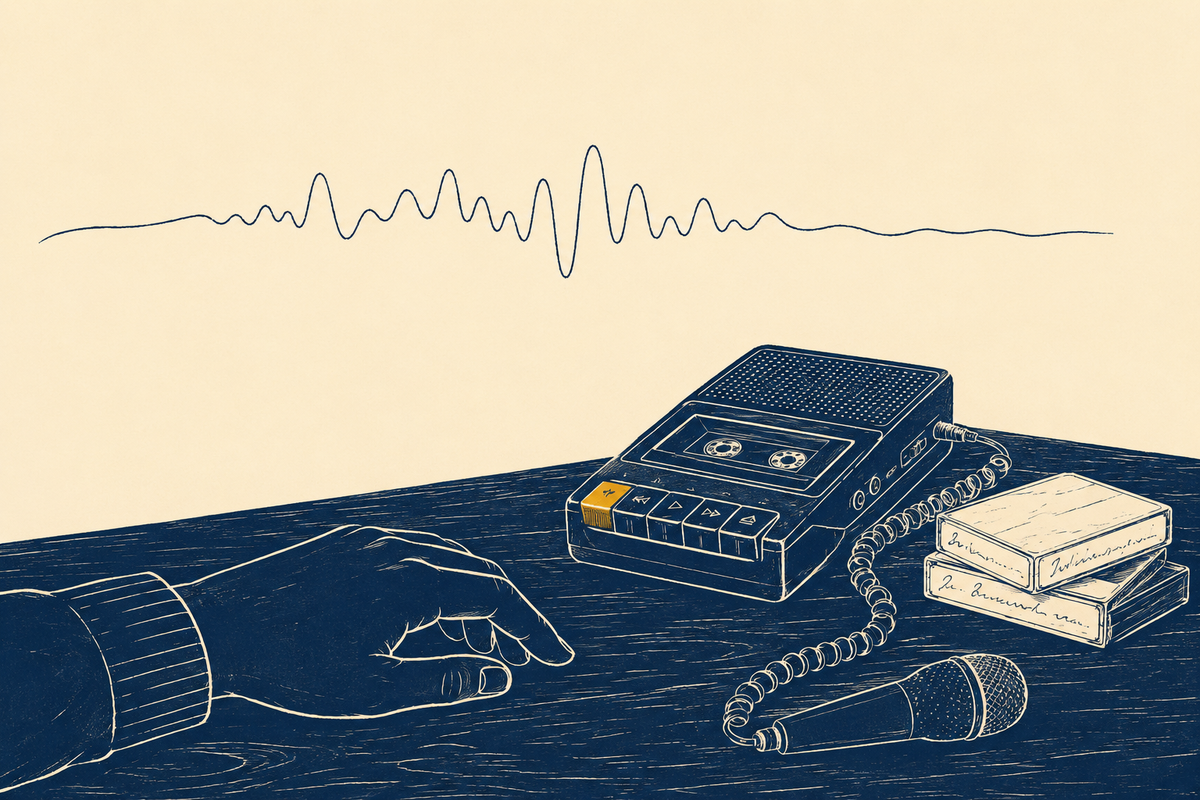
Take a composite. It could be any number of the heritage charities I have spoken with. A small organisation holds three decades of oral history recordings, community photographs, exhibition catalogues and event documentation. The material is technically public. Practically, it is buried. Scattered across hard drives, half-indexed PDFs, and a website built in 2014 that nobody has the budget to rebuild.
A researcher wanting to find a particular interview has to know it exists first. A community member curious about their own family history has nowhere to start. The collection is rich and largely invisible.
For organisations like this, the question isn't “how do we replace people with AI?”
It's “how do we help people find what is already here?”
That is a very different conversation.
Used carefully, AI can support archive discovery, improve accessibility, help visitors navigate large collections, assist staff with internal research, and surface connections that might otherwise remain hidden.
But none of that matters if trust collapses.
And trust isn't built through bigger models or louder promises. It's built through boundaries. Clear consent processes. Human review at every stage. Transparency about what systems can and cannot do. Respect for sensitive material. Institutional control over data. A willingness to acknowledge uncertainty rather than pretend machines are objective.
Most cultural organisations don't need an AI system that speaks with false authority about everything. That may be the fastest route to damaging public trust.
What they need are small, careful systems designed around real institutional needs. A private archive guide built only from approved material. An internal assistant that helps staff locate information across fragmented collections. A pilot project that improves accessibility without turning cultural memory into content sludge.
Not every archive needs a chatbot. Not every collection should become an AI product. Some things should remain slow, human, and deliberately difficult. Friction is not always failure. Sometimes it is part of what gives cultural material meaning.
This is where technology conversations often go wrong. Efficiency gets treated as an unquestioned good. But cultural memory does not operate like food delivery logistics or advertising optimisation. A community oral history archive is not “underperforming content.” A testimony is not raw material waiting to be mined for engagement.
The cultural sector understands something the technology industry sometimes forgets.
Trust is relational.
People want to know who built this, whose values shaped it, who benefits, what happens to the material, whether mistakes can be corrected, and where the boundaries lie. These are not obstacles to innovation. They are part of what responsible innovation actually means.
If anything, this raises the standard for the kinds of systems worth building. The future of AI in cultural spaces will depend less on what the technology can do, and more on whether the people whose histories it touches feel respected by the systems being built around them.
Trust cannot be automated.
It can only be earned.